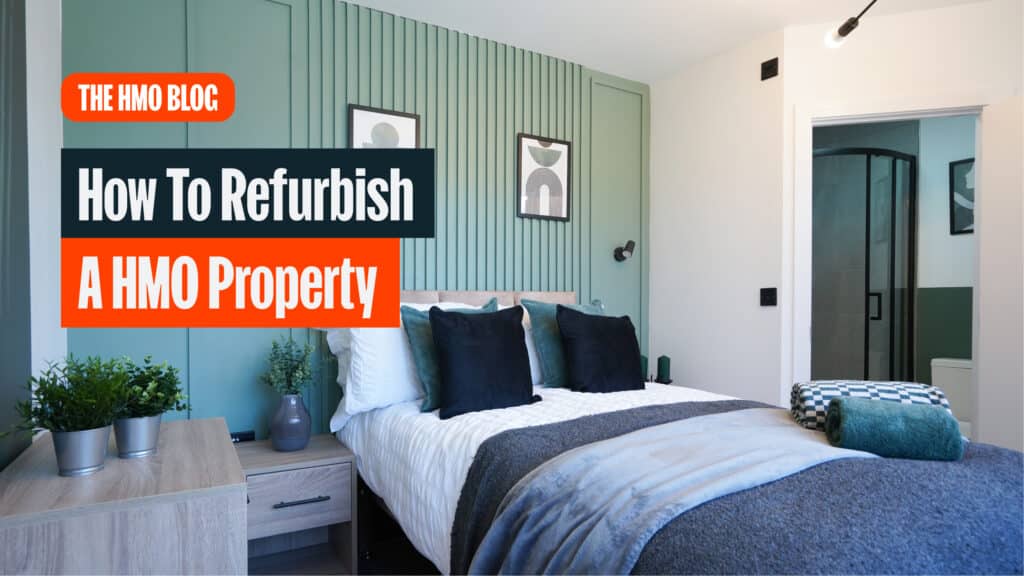
Photo by WJF Developments
Refurbishing a HMO is a key part of ensuring your property is profitable and making the space right for your target demographic. To effectively do this, you need to understand what’s involved in planning and undertaking a HMO refurbishment. This includes setting budgets, mitigating risks and transforming the property.
It doesn’t matter how small a refurb is, the process can still be complex, and refurbs are particularly risky for first-time investors. But careful planning and a tenant-first approach can help ensure the renovation is as successful as possible.
In this blog, we’ll discuss what to expect when it comes to HMO refurbishments, what work to consider, how to budget, what contingencies to put in place and advice on how to do this even on a budget!
What Work to Do
When purchasing a property you want to convert into a HMO, there are likely certain upgrades or changes you need to make in order to ensure the property will be compliant with amenity standards. Or you may need to add value to be able to achieve certain rents – or both!
It can be tricky to decide what work you should do as part of converting or refurbishing HMO properties. Start by looking at what the competition is doing in the local area and figure out what’s appealing and valuable to your target tenant demographic. Then, consider your own primary goals. Are you needing to improve functionality, increase space or enhance aesthetics?
When planning your refurbishment, think about tenant experience, layout optimisation and quality of the finish. You’ll need to balance the number of rooms and tenant comfort. Each room must meet HMO licencing requirements, but it’s also recommended to not only aim for the minimum standards.
Focus on making improvements for the long term and avoid cutting corners with cheap materials as this will end up costing you more in the long run. This is all crucial in making sure that the end result of your refurbishment is as close to where you want and need it to be!
What to Expect
There are a few things to be aware of when it comes to refurbishing any HMO property, including planning permission, building regulations and licencing.
Planning Permission
The planning stage can determine whether you can convert a property to a HMO or undertake certain renovations. Many otherwise promising schemes stall or fail because of avoidable mistakes or due to investors not considering or understanding certain things about planning permission from the outset!
There are a few things you need to make sure you understand and are aware of before converting a property into a HMO, including permitted development rights, change of use and Article 4 directions. Ideally before buying a property, you need to know whether you need planning permission for what you plan to do to a property.
Check with the local authority if your renovations require approval, especially for extensions or structural changes. If you do, you’ll need to pay for a planning application fee, and it might also be beneficial to work with a planning consultant.
Building Regulations
Building regulations are a set of guidelines and standards that govern the construction, alteration and maintenance of buildings. When planning to undertake certain building work, you’ll need to submit a building regulations application to the relevant building control body.
This application should include detailed plans and specifications for the proposed work, as well as any calculations and test results that demonstrate compliance with the building regulations.
It is important to note that failure to comply with the building regulations can result in serious consequences. Local authorities have the power to issue penalties for non-compliance, including fines and even imprisonment.
HMO Licencing
To have a HMO in the UK, you may need to have a HMO licence depending on the number of occupants and the local authority the property is located in. Licensing for HMOs was brought in to improve the quality of housing, but not all HMOs require a licence.
There are three different types of licensing measures that are important to be aware of to ensure you remain compliant.
- Mandatory Licencing: This type of licencing requires all HMOs with five or more people from at least two different households to obtain a licence nationwide.
- Additional Licencing: This requires all HMOs with three or more people from two or more households to obtain a licence. This might only apply to certain areas in the region or strictly to buildings over a certain number of storeys.
- Selective Licencing: This requires all privately rented properties in a specific area to have a licence – no matter the number of occupants. This is typically targeted on street or ward levels, especially in areas known to have the lowest quality housing.
Even if your property doesn’t require a HMO licence, you’ll still need to adhere to a number of standards when renting out a HMO. There are national standards set centrally by the government, but local authorities can also insist on their own stricter standards.
When spec-ing out a refurbishment, you need to know exactly what the licence requirements are in your area and how these rules are interpreted by your local council as there can be many grey areas. Keep in mind that amenity standards and bedroom sizes will heavily impact what it’ll cost to refurbish a property and convert it to a HMO.
How to Budget
No matter how small or big the refurb is that you’re planning to undertake, it can be challenging to estimate the costs, especially if you’re new to HMO investment. You’ll need to get quotes from contractors, and unforeseen costs and issues will often crop up when refurbishing a property. So, you’ll also need to leave room for the unexpected!
What you’ll end up spending on a renovation will depend on the current condition of the property and what spec you’re looking to create, but be sure you set a realistic budget. I’ve seen some investors do creative renovations for a relatively small budget of £25k, but I’ve also seen the other end of the spectrum where investors spend more than £100k on a refurb to create a really high spec.
Think about whether you’ll need to hire an architect for your HMO project. This will usually depend on your experience and project type. It’s recommended to work with one if you’ll be dealing with a change of use, doing any structural changes or want to change the floor plan. But if you’re doing very minor changes, you might not need one.
Putting Contingencies in Place
As an investor, you have to be comfortable with taking financial risks. It’s part and parcel of property investment, and investing in HMOs is particularly capital intensive. Budgets and timelines can over-run, refurbs can take longer and material and labour costs can increase.
These challenges can really mount up, and a contingency that you might have on a project can vanish very quickly. All of this can then significantly impact what you’re able to do with a project.
These are the things we often don’t put in the spreadsheet, but they can be really expensive and increase risks and pressure. Because of all of this, stress testing is so important to understand. If you end up pushing yourself too far, that can be catastrophic!
As the one consistent feature of any refurb is unforeseen issues and costs cropping up, mitigating risks where possible and putting contingencies in place can help ensure your property remains successful and sustainable no matter what’s thrown your way. And you can mitigate many of the risks associated with doing a refurbishment by planning well in advance.
Tips for Refurbishing a HMO on a Budget
Not everyone is able to or willing to invest six figures in a refurbishment… That kind of budget provides the scope to convert lofts and garages, add an extension, go back to brick and invest in premium fixtures, fittings and finishes.
It’s much more challenging to genuinely add value and push rents up off the back of smaller HMO refurbishments. However, if you’re smart about how you spend your money and focus on the right things, you can still achieve this.
With tenant expectations shifting and higher build costs, it’s more important than ever to invest in the right property renovations that offer the strongest return on investment, so here are some of my top tips on how to do that on a budget!
- Modernise the Kitchen & Bathrooms
With a small refurbishment budget, we don’t have the money to completely rip out the kitchen and bathrooms and replace them. So, what can you do?
If you can spray or vinyl wrap the kitchen and replace the worktops and tile splashback, the kitchen can look brand new. This is great if you’ve got a kitchen that’s in reasonable nick, but it just looks a bit crap or it’s not working with your design concept.
It’s tricky to do much on a low budget in bathrooms, but toilets, sinks and breast taps can often look old fashioned. So, it’s worth spending some money on updating the sanitary wear and shower to more modern options. If you have a cool design concept running through your HMO, don’t let the bathrooms really drag it down and look completely out of place.
- Incorporate Feature Walls & Panelling
Feature walls can completely transform a room and enhance the whole look and feel of a property. This can include using interior panelling or cinema walls, adding colours or incorporating special design features.
I’d recommend focusing on the communal spaces, and typically the living room is the big one as it’s one of the first rooms anybody will see. You need to use durable materials because you’re going to get a lot of people and traffic moving through.
- Add Feature Lighting
Invest in feature lightning in community areas, but use it sparingly as this can get expensive. If you start trying to add feature lighting into bedrooms and hallways, that’s a lot of wiring that has to be done.
Rather than just having a single pendant in the living room with a bulb in it, do something interesting or buy a special type of pendant or interesting lighting. Consider using spotlights in a specific area of the kitchen.
- Optimise Extra & Awkward Spaces
Make sure you’re using whatever space you’ve got as well as you possibly can. One of the most important things that you can do, particularly if you’re on a small budget, is utilise things like alcove spaces.
In an ideal world, we’d rip out awkward spaces like chimney breasts in a living room as you could put a feature wall across it, build out the alcoves and then you could almost build it into a cinema space.
Another good way to utilise awkward alcove spaces, particularly in kitchen-dining spaces, is by putting perching zones in. So, almost like a small breakfast bar with two stools, or a separate table and sofa.
- Invest in New Flooring
Don’t try and get away with old carpets as that will stand out. Spend a couple of grand on some new flooring. To keep it affordable, use a commercial grade laminate through the communal spaces downstairs and into the kitchen if possible.
You can also recarpet the rest of the house with an underlay on a relatively low budget. I’d recommend going with a fairly neutral shade like a light grey or brown with a low pile.
Planning Your HMO Refurbishment
There are some key things you need to understand and be aware of when refurbishing your HMO properties. If you’re able to do this well, you’ll be able to create the right spaces for your tenants, increase your profits and build a successful and sustainable HMO portfolio!
To access training, lessons and resources to help you refurbish HMO properties, become a member of The HMO Roadmap today! You can also gain access to case studies and templates to help you with this part of investing in HMOs. If you have questions or would like to discuss anything about HMO investment with fellow investors, be sure to join us over in our free Facebook group The HMO Community.

About the Author:
Andy Graham is the founder and the lead trainer at The HMO Roadmap! He writes as a regular columnist in different magazines about a variety of HMO topics and is the host of The HMO Podcast! Follow Andy on Instagram!