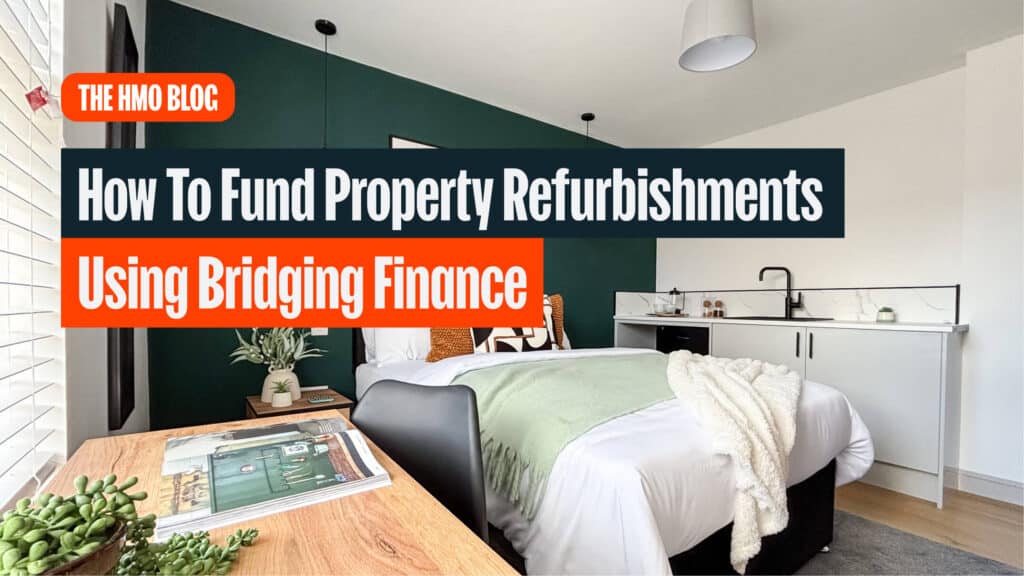
Photo by Snug Properties
This month, we’re talking about one of the most common challenges property investors face: finding the funds to complete refurbishments and add value to a property.
With property sales taking longer than ever and vendors wanting more certainty around transactions, bridging finance is becoming an increasingly useful tool. However, many investors are still nervous about using it. The perception is often that it’s expensive and only for experienced developers, but bridging finance can be incredibly effective when used correctly.
Whether you’re buying a property that won’t qualify for a standard mortgage, converting an HMO, or carrying out a refurbishment to increase value and rental income, bridging finance can help you move faster and maximise your returns.
Why use bridging finance?
There are several reasons why investors choose bridging finance:
- It allows you to buy properties that are otherwise unmortgageable. You effectively become a cash buyer. Properties without kitchens or bathrooms, those in need of significant refurbishment, or properties where the planning or usage isn’t currently correct can often be purchased using bridging finance.
- It allows you to move quickly. This may or may not be important depending on the deal, but bridging lenders can often complete within a few weeks. If you’re purchasing from a motivated seller or negotiating a discounted price in exchange for a fast completion, this can be a huge advantage.
- It allows you to purchase a property, complete the required works, and then refinance onto a longer-term mortgage using the new, higher value. In many cases, you can do this without any early repayment charges.
- It allows you to borrow up to 75% of the purchase price, even where rental stress tests would prevent you achieving the same leverage on a standard buy-to-let mortgage. Following a successful refurbishment, the improved rental income should then support the refinance onto a traditional mortgage product.
Funding refurbishment costs
One of the biggest advantages of bridging finance is that, in certain circumstances, it can help fund your refurbishment costs as well as the purchase itself.
Upfront funding towards refurbishment works
We work with a number of lenders who will allow investors to maximise the day-one loan. Depending on the deal, we can achieve up to 80% net, or even 85% in certain scenarios.
This works particularly well for lighter refurbishments where the EPC isn’t sufficient, or the property isn’t currently lettable due to décor, floor coverings or general condition.
It can also work for HMO conversions and heavier refurbishments where there are no structural changes to the property.
If you already have funds available for the refurbishment works, this can be an excellent option. The product is relatively straightforward to arrange, and you don’t need to worry about staged drawdowns after completion.
Borrowing refurbishment costs in arrears
For larger refurbishment projects, development opportunities, or conversion schemes, you may be able to borrow refurbishment costs in arrears.
Typically, the lender will provide up to 75% of the purchase price and then reimburse refurbishment costs as the works progress.
There are still lending limits to consider. In many cases, borrowing is capped at around 70% of the Gross Development Value (GDV). However, where the project demonstrates strong profitability, some lenders may allow borrowing up to 90% of the total project costs.
Generally, refurbishment budgets need to be at least £80,000 before this structure becomes worthwhile. You’ll need sufficient working capital to fund initial stages of the project before reclaiming costs from the lender, as well as funds towards your purchase deposit.
This type of funding is particularly useful for:
- Larger refurbishment projects
- Commercial-to-residential conversions
- HMO conversions
- Development projects
The key benefit is that it allows you to minimise the amount of your own money tied up in each project, helping you complete multiple projects simultaneously and grow your portfolio more quickly.
What are the disadvantages?
Bridging finance isn’t the right solution for every deal.
If you have access to cheaper sources of funding, such as releasing equity from another property, a family loan, or gifted funds, it may be worth comparing the costs.
However, it’s important to remember that bridging lenders also provide independent valuations and legal due diligence. These checks can help identify issues and reduce risk, so the decision shouldn’t be based purely on interest rates.
Bridging finance is typically the most expensive form of property borrowing because it carries greater risk for the lender. You must factor all finance costs into your appraisal and ensure the deal remains profitable.
If it doesn’t stack up after finance costs, I’d argue it’s probably not a good enough deal.
Understanding the full costs
Where I see investors run into difficulties, it’s usually because they haven’t fully understood all the costs involved.
Beyond the headline interest rate, there may be:
- Exit fees
- Monitoring fees
- Valuation costs
- Legal fees
- Extension fees
Understanding the full cost of borrowing before you proceed is essential.
We only work with reputable lenders who are transparent about their fees and who deliver on what they say they will. Unfortunately, there are still lenders in the market who aren’t as clear, so it’s important to carry out your due diligence.
Final thoughts
As always, success comes down to understanding your numbers, carrying out proper due diligence, and working with the right people.
Bridging finance should be viewed as a tool rather than a long-term solution. When used correctly, it can help you unlock opportunities, add value to properties, recycle capital, and grow your portfolio more quickly.
Many of our clients use bridging finance successfully because it allows them to extract funds from completed projects and reinvest into the next opportunity.
If you’d like to discuss a specific deal, or simply have a chat about your plans, please feel free to book a call.

About the Author:
Ellie Broadhurst is a specialist mortgage broker working at Baya Financial in partnership with The HMO Roadmap. She works with HMO property investors throughout their journey, from clients starting on their first project through to experienced portfolio landlords and developers. Learn more about Ellie here.