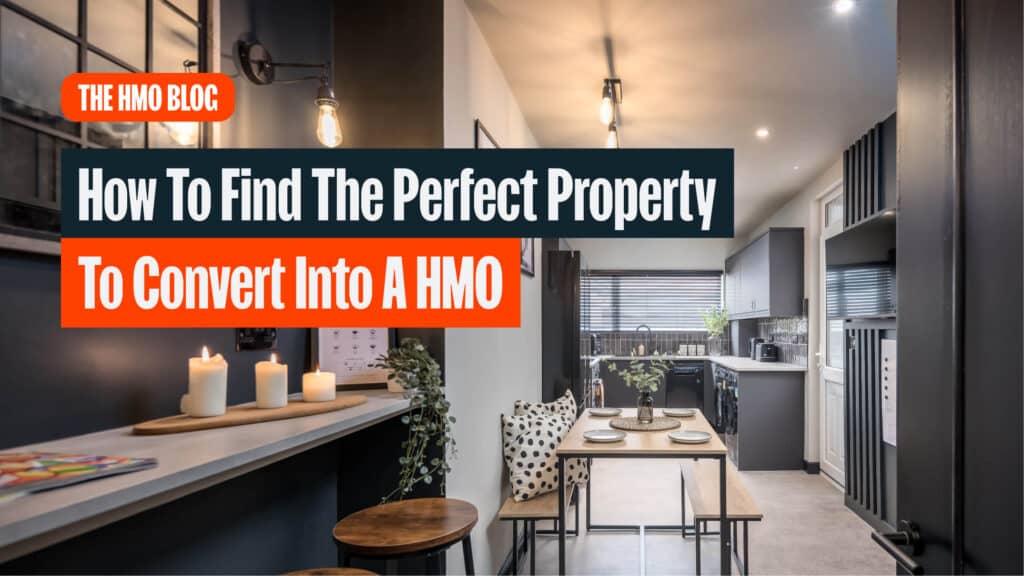
Photo by Wilson Finch Properties
Finding the perfect property to convert into a HMO can be tricky. It can be overwhelming figuring out the things you need to look out for and keep up with it if you’re wanting to grow your HMO portfolio.
There are lots of things to think about and consider when it comes to finding properties to convert into HMOs. In this blog, we’ll discuss a couple of the key pillars of finding the right properties, things to understand and areas of opportunity when it comes to converting properties into HMOs!
Key Pillars of Finding Properties
It’s important to understand exactly what you’re looking for before you even start the process of searching for your next property. Doing this at the outset will make it easy for you to identify properties that will and won’t work to convert into the type of HMO you want to create. So, here are two of the main pillars of finding HMO properties!
Location
As we all know, location is absolutely crucial. It determines the supply and demand, a property’s desirability and resale-ability and the prospect of capital appreciation. Consider what amenities and features a specific location offers and what regeneration programmes are in place.
Make sure you think about these factors. But above all, if there isn’t consistent demand from your target tenant demographic for the property you’re going to convert, then don’t waste your time on that location!
Take the time to do all the research first, so you can really hone in on one area and fully understand the location you’re targeting. You really should be narrowing your focus down to just one single area.
Size
You need to consider the size of property you’re going to look for and how many bedrooms it will have once converted. Be sure to understand the different licensing requirements for small and large HMOs.
When looking at the size of properties, start by breaking it down by the average pound per square foot. This will help you get a broad average of what properties cost in a specific location.
Then, begin looking at the specific requirements and fundamentals you need in a property, such as the current number of bedrooms and the features that’ll be key to allow you to convert it into a HMO or add space if you want to create additional bedrooms.
The property will need to be a particular size to start with and have the ability to add space as this can also help you recycle some capital by adding value.
When you know exactly the kind of property and size you require for your HMO investment strategy, you can easily factor this into your search criteria. By being specific, you won’t waste your time looking at any other kind of property!
Things to Understand
There are a few things you need to make sure you understand and are aware of before converting a property into a HMO, including permitted development rights, change of use, Article 4 directions and evaluations and appraisals.
Permitted Development Rights & Change of Use
Permitted Development Rights allow you to undertake certain types of building work or to carry out a change of use without submitting a full planning application. These rights are granted by the Town and Country Planning (General Permitted Development) Order 1995.
Think of this as a fast-track route… If your proposal fits the rules and your location allows this type of development, you can often skip the delays, headaches and objections so often associated with planning!
For example, when it comes to change of use, Commercial to Residential (Class MA) is one of the most investor-friendly routes. This allows numerous commercial buildings, offices, shops, gyms and more to be transformed into residential units.
But keep in mind that Permitted Development Rights are not universal. They can vary based on location, property type, and the specific conversion or development you’re proposing. When converting a property into a HMO, it’s important to be aware of what you could or couldn’t do through PD rights.
Article 4 Directions
Local Planning Authorities have the power to remove Permitted Development rights through Article 4 directions. Once an Article 4 is made, certain types of PD rights are removed and will require planning permission to be applied for.
Article 4 directions allow LPAs to have more control over the types of development that take place in that area. One of the most common examples of this is removing the PD right to convert a house into a HMO.
Other examples of development that are sometimes restricted by an Article 4 direction include the conversion of a building into flats, changes to the front of a building, installation of new windows or doors and the installation of new satellite dishes.
These conversions and developments can sometimes be considered to have a negative impact on the appearance and character of an area, so an Article 4 direction can be used to ensure they are not allowed without planning permission.
Evaluations & Appraisals
To understand if a property would be perfect to convert into a HMO, you need to be able to appraise deals and understand what exactly makes a good HMO deal. There are 10 points you should stress test in every deal evaluation. This will help you see what a deal might look like under any circumstances.
You need to not only be able to effectively undertake a deal appraisal but also understand what the numbers actually mean. If you’re not as comfortable with this, spend some time learning about deal evaluations, the numbers involved and how to interpret what this information is telling you about a specific property or deal.
To help you with this, you could use your own spreadsheet or the Deal Appraisal Stacker inside The HMO Roadmap will allow you to assess the performance of deals.
Once you’ve really understood deal evaluations, you should know what your perfect property and deal looks like. Make sure that’s then the only thing you go out shopping for. This will allow you to set search filters, communicate with agents and know exactly what to tell people you’re looking for. Then it’s time to start doing viewings!
Areas of Opportunity When Converting HMOs
There are a number of areas of opportunity when it comes to converting a property into a HMO, so here are a few things to keep an eye out for when you’re looking for your next investment!
1. Potential for Extending & Expanding
As adding space can be essential to successfully convert a property into a HMO, it can be helpful to look out for the potential to expand and extend a property through a garage and/or loft conversion and extension.
Loft Conversions
Loft conversions can be particularly efficient, often delivering some of the strongest ROI! You could consider adding a dormer via a loft conversion, but keep in mind that dormers can only be added to the rear of properties. For example, if you have a back-to-back terrace and want to add a dormer to the front, this would not be allowed through PD rights.
Additionally, any additional space cannot exceed 50 cubic metres for detached or semi-detached properties and 40 cubic metres for terraced houses. However, this does include any previously created roof space even if this was made by a previous owner.
Extensions
Single and double storey extensions are allowed to the rear of your property under PD. No more than half of the area of land around the ‘original house’ can be covered by any extensions or other buildings, which includes outbuildings and sheds.
The term ‘original house’ means the house as it was originally built or as it stood on the 1st July 1948 if it was built before that date. There are specific maximum height and width you must be inside of and these are different between single and double-storey extensions.
Side extensions are also allowed through permitted development, but they can only be single-storey and are not allowed on side elevations that front onto a highway. There are specific maximum height and width you must be inside of as well.
However, when planning to undertake any permitted development, be sure to check the property isn’t within an Article 4 area or on designated land as these can either stop you from being able to do this or alter the rules on what you’re allowed to do.
2. Create More Bedrooms with Consideration
Adding a bedroom can substantially increase both resale value and yield, especially in family-focused areas and rental hotspots. However, more bedrooms should not come at the expense of liveability.
Avoid sacrificing essential living space or squeezing in box rooms. Modern tenants will be looking for high-quality design and keep in mind amenity standards, especially when it comes to room sizes, and any other licensing requirements
3. Adding Value
Adding value can help you maximise rental income, long-term growth and resale potential, which can be key to ensure your HMO business remains successful and sustainable. When it comes to adding value, it isn’t just about improving how a property looks, it’s about prioritising strategic upgrades.
With tenant expectations shifting and higher build costs, it’s more important than ever to invest in the right property renovations that offer the strongest ROI. Here are some of the key improvements that often deliver:
- Improve the layout
- Smartly upgrade kitchens and bathrooms
- Enhance energy efficiency
- Think about curb appeal
4. Ugly Listings
Don’t overlook ugly listings on property portals, commercial websites and auction houses as these can be great opportunities! Keep an eye out for properties with poor pictures of the garden or interior… Or maybe there’s a picture of the road and you can’t even tell what property you’re looking at.
If you look for these kinds of properties, you’ll likely face less competition. They can put some people off straightaway, but there still be plenty of potential to convert it into a HMO if it’s in a good location with a good floor plan.
Go out of your way to look for ugly listings. If you can get in the habit of doing this, you’ll end up finding better properties to convert into HMOs with less competition and at better prices!
5. Big, Boxy Floor Plans
As HMO investors typically want as many rooms as possible inside a house, you won’t want to spend much time looking at properties that will be too challenging or tricky to convert into a HMO.
So, look out for properties that indicate large, boxy floor plans with high-pitched roofs and garages that could potentially be convertible. The more you get used to searching for these types of properties, the easier it’ll be to wade through listings to find the right properties.
If a property has a good floor plan to start with and you don’t have to move staircases, it will be easier to put up partitions to split big bedrooms into two.
Make sure you’re not wasting time looking at overly-complicated floor plans that would need too much work to turn it into a HMO and the property that you need. Personally, I keep an eye out for former local authority houses as they typically have useful floor plans for converting into HMOs.
Start Finding the Right Properties for HMO Conversions
These are some of the essential things you need to be aware of and to understand when looking for the right properties for HMO conversions. If you’re able to do this well, you’ll be able to seek out the right properties and build a successful and sustainable HMO portfolio!
To gain access to training and resources to help you expertly find and convert properties into HMOs, sign up for The HMO Roadmap today! You can also gain access to our case studies, lessons and even a deal stacker to help you evaluate and appraise deals.
Be sure to also join us over in our free Facebook group The HMO Community where you can ask your burning questions or discuss anything about HMO investment with fellow HMO investors for inspiration and support.

About the Author:
Andy Graham is the founder and the lead trainer at The HMO Roadmap! He writes as a regular columnist in different magazines about a variety of HMO topics and is the host of The HMO Podcast! Follow Andy on Instagram!